Although I've recently covered a type of Japanese music in previous blogs (Kabuki), I thought I'd go more in-depth about each of the traditional instruments that are used in Japanese music. I'll also be exploring modern Japanese music and the type of syncretism that evolved over time in Japan.
We'll start from the beginning, with traditional music first, working our way up to the modern age.
Traditional Japanese music is my favorite. Since I practice Kendo, which is a form of Japanese Fencing and martial art passed down for hundreds of years; I always like to play traditional Japanese music on the way to class. It helps me get into the Japanese warrior spirit and it mentally prepares me for what I'm about to endure. In case you're wondering what Kendo looks like, here is a very quick description below.
Let's talk about the music now.
Japanese music can be traced back over 1000 years. It has both secular and sacred themes. It's played in both royal courts and public theaters. Some of the more well-known instruments are described below along with video examples for each one.
The Shamisen
is a plucked chordophone with 3 strings stricken by a large triangular pick. It is one of the more famous and versatile instruments. It can accompany other instruments, especially in Kabuki, or play melodies on its own. It is often featured in many anime shows as well.
The Biwa
is a Japanese, short-necked wooden lute traditionally used in narrative storytelling. It was first made popular in China before reaching its way to Japan during the Nara period (710–794) So, this is an ancient instrument. Centuries ago, Biwa musicians were mainly blind monkswho used the Biwa for musical accompaniments during scriptural readings.
The Shakuhachi
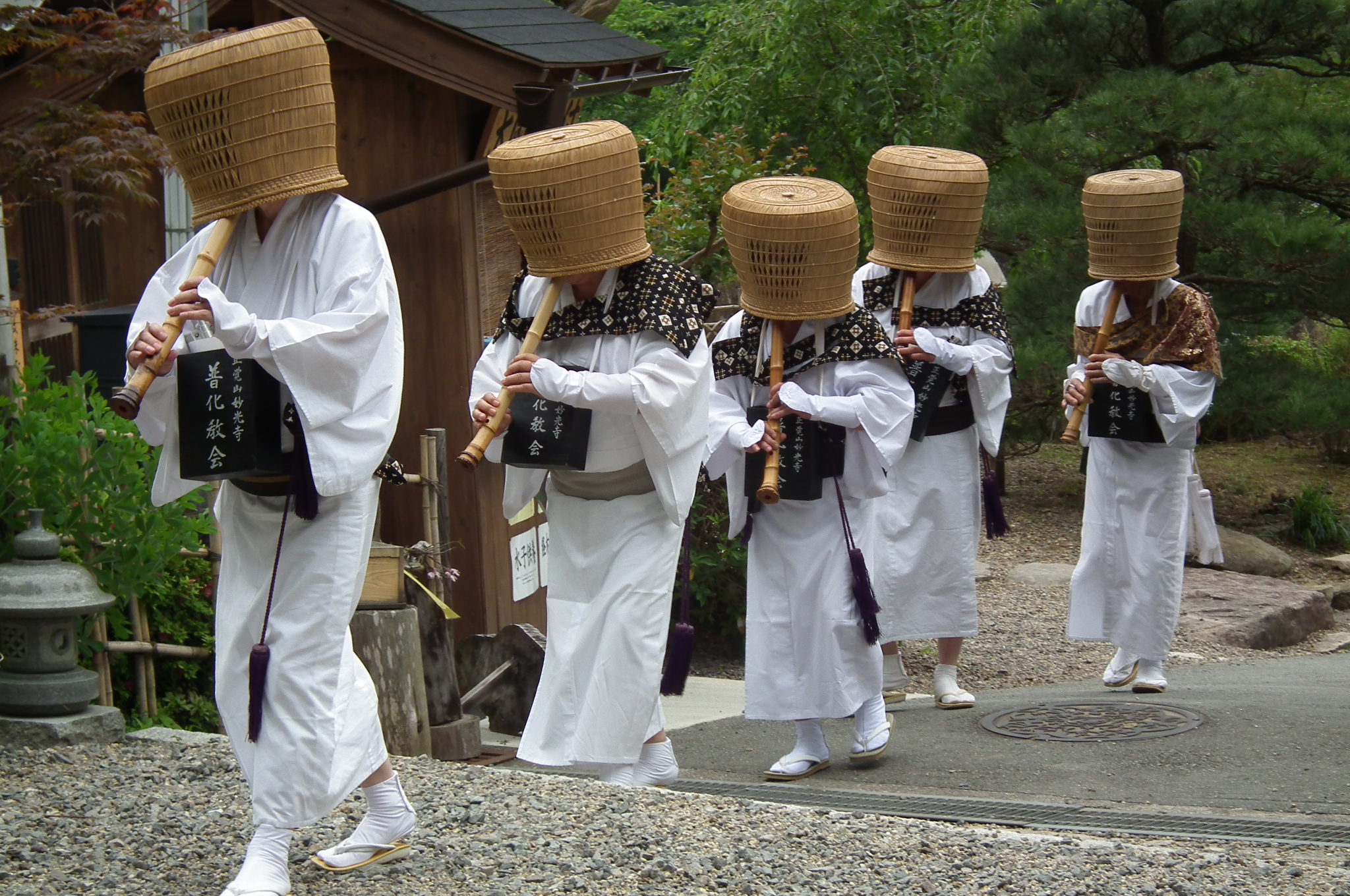
is a pentatonic, bamboo, end-blown flute with 5 holes. It is made especially famous by the Komusō; who were a group of Japanese monks of the Fuke school of Zen Buddhism.
They are known to wear a straw-woven basket on their heads (The basket is known as Tengai) with the purpose of dissolving their egos while also hiding their identities. Travel was especially strict during the Edo period. Some of the monks were warrior monks and former Samurai called Ronin. This made being incognito especially important. Originally, playing the shakuhachi was for meditative purposes and less so for entertainment.
Sketch
After the Tokugawa shogunate fell to the loyal forces of the Emperor, Komusō temples and their monks were abolished in 1871. However, playing the shakuhachi and its repertoire survived.
The Koto
is the national instrument of Japan. It is originally derived from the Chinese Guzheng or Zither, introduced in the 7th or 8th century. The first Koto was known to have 5 strings, later 7. The koto is a type of harp played on the floor, with 13 strings. (sometimes up to 25 or even 31 strings) It also has movable bridges. It is played with little picks attached to the musician's fingers.
Originally, the koto was forbidden to be played by women. When these strict rules were finally lifted, many women began to master the koto.
The Taiko
is a broad range of Japanese percussion instruments. The term Taiko refers to any kind of drum.
Kumi-daiko is referred to as a set of drums. Taiko drums have a mythological origin in Japanese folklore. Historical records indicate that the taiko were introduced by Chinese and Korean cultural influence as early as the 6th century CE. Pottery found from the Haniwa period is seen depicting taiko drums. Some taiko drums are similar to drums originating from India. Archaeological evidence shows the presence of taiko drums as far back as the 6th century; during the Kofun period. (300-538 AD) Their functions varied throughout history, such as communication, (especially for military purposes) theatrical accompaniment, religious ceremony, and concert performances leading up to today. Here are some examples.
The first video features a large Taiko drum accompanied by a shamisen.
The second video features 3 large taiko drums played by 3 drummers, The "3 tears" symbol painted on these drums is a well-known Japanese family crest. It means
"Death Before Dishonor"
The Hyōshigi
is a simple and easily recognizable Japanese traditionalinstrument consisting of two pieces of wood or bamboo often connected by a thin decorative rope. The "clappers" are played together or on the floor to create a cracking sound. Sometimes they are struck slowly at first, then faster and faster. They are primarily used in Japanese theater, especially Kabuki, to announce the beginning or end of a performance.
It took me literally an hour at least, to find the original video clip here below. Apparently, some people found it funny to add memes right at the end when he demonstrates the sound. Here is the original clip. Trying to find this original clip almost drove me insane. It's only short of a minute long.
Enjoy.
Below is another great example of various Hyōshigibeing demonstrated.
There are a handful of other traditional wind instruments I didn't mention. If you want to learn more about those, here is a great source that ties all of this together. It's kind of long, about 30 mins but I encourage you to watch it. It's very informative!
Onto modern Japanese music!
During the 19th century, Japanese music takes a different route. That is taking the influence of Western music which became very popular at the time. Japan quickly became a major consumer of Western music which evolved Japanese music forever. In 1885 Gunka, a term for Japanese military music became popular and was the most prevalent music being performed and listened to at the time. It contained local and foreign repertoire. During the early 20th century, (1930s-1940s) Japan started to diversify even more. Military music was still relevant, but in the 1930s Jazz hit the scene and was a major hit. Later, In the 1960s they inducted rock n roll music or J-rock. Other sub-genres were budded from this movement such as psychedelic and pop-rock. In the 1980s, during the height of Japan's economic boom, birthed other genres, from techno to punk, progressive rock, and even heavy metal. Immediately following the 80s, the emergence of Japanese hip-hop stemmed a growth of dance music and pop music coining the term "J-pop."
In the early 2000s, audiences, especially in Tokyo were more drawn to these genres than all five generations of music prior to this; where J-pop and hip-hop still reign supreme to this day.
However, there are groups that like to combine traditional Japanese instruments with Western rock and pop music such as "Wagakki Band". This band is a very famous music group from Japan that I accidentally stumbled upon a few years ago on youtube. In these clips, you will see an example of syncretic Japanese music. I hope, given the previous context, you can come to appreciate Wagakki band too!
To keep it short, please skip to minute 3:46 in the middle of the video to the left. You will notice the Koto right away. You'll notice a guy who appears as a monk, skillfully playing shakuhachi. Then the main vocalist begins and another girl joins in with her shamisen. Also, here's a tip; Go to the bottom of the video and click CC for the subtitles so you can understand what's being sung.
For the video to the right, skip to 3:40. You will first notice the Taiko in this one, along with the amazing shakuhachi and shamisen players.
If you took the time to read and watch the videos, thank you. I hope you learned some things and found an appreciation for traditional Japanese instruments.
Japanese music sounds similar to Chinese music yet it is so different. For instance, Chinese music seems to sound more happy and fast as opposed the Japanese music. I enjoyed reading and learning more about the various Japanese instruments and the styles of Japanese music. It would be neat to visit Japan one day! (My mother was born in Japan since my grandfather was stationed there. He was in the Air Force.)
Hi Jaccob, thanks for sharing the culture and music of the east to the west, it is a very precious opportunity. Japanese as our neighbour of China, to our knowledge, they are very good at absorbing good cultures and techniques, and they can rapitly develop and creat new things on it to make it very great. I think in music, they also do the same, it is no doubt that Japanese music and culture are very influencal in the west, more than that of Chinese culture. Thanks again for sharing the east!


Japanese music sounds similar to Chinese music yet it is so different. For instance, Chinese music seems to sound more happy and fast as opposed the Japanese music. I enjoyed reading and learning more about the various Japanese instruments and the styles of Japanese music. It would be neat to visit Japan one day! (My mother was born in Japan since my grandfather was stationed there. He was in the Air Force.)
ReplyDeleteHi Jaccob, thanks for sharing the culture and music of the east to the west, it is a very precious opportunity. Japanese as our neighbour of China, to our knowledge, they are very good at absorbing good cultures and techniques, and they can rapitly develop and creat new things on it to make it very great. I think in music, they also do the same, it is no doubt that Japanese music and culture are very influencal in the west, more than that of Chinese culture. Thanks again for sharing the east!
ReplyDeleteThis is very in-depth and informative! I didn't realize how much music is important to the wide culture of Japan!
ReplyDelete