Although I've recently covered a type of Japanese music in previous blogs (Kabuki), I thought I'd go more in-depth about each of the traditional instruments that are used in Japanese music. I'll also be exploring modern Japanese music and the type of syncretism that evolved over time in Japan.
We'll start from the beginning, with traditional music first, working our way up to the modern age.
Traditional Japanese music is my favorite. Since I practice Kendo, which is a form of Japanese Fencing and martial art passed down for hundreds of years; I always like to play traditional Japanese music on the way to class. It helps me get into the Japanese warrior spirit and it mentally prepares me for what I'm about to endure. In case you're wondering what Kendo looks like, here is a very quick description below.
Let's talk about the music now.
Japanese music can be traced back over 1000 years. It has both secular and sacred themes. It's played in both royal courts and public theaters. Some of the more well-known instruments are described below along with video examples for each one.
The Shamisen
is a plucked chordophone with 3 strings stricken by a large triangular pick. It is one of the more famous and versatile instruments. It can accompany other instruments, especially in Kabuki, or play melodies on its own. It is often featured in many anime shows as well.
The Biwa
is a Japanese, short-necked wooden lute traditionally used in narrative storytelling. It was first made popular in China before reaching its way to Japan during the Nara period (710–794) So, this is an ancient instrument. Centuries ago, Biwa musicians were mainly blind monkswho used the Biwa for musical accompaniments during scriptural readings.
The Shakuhachi
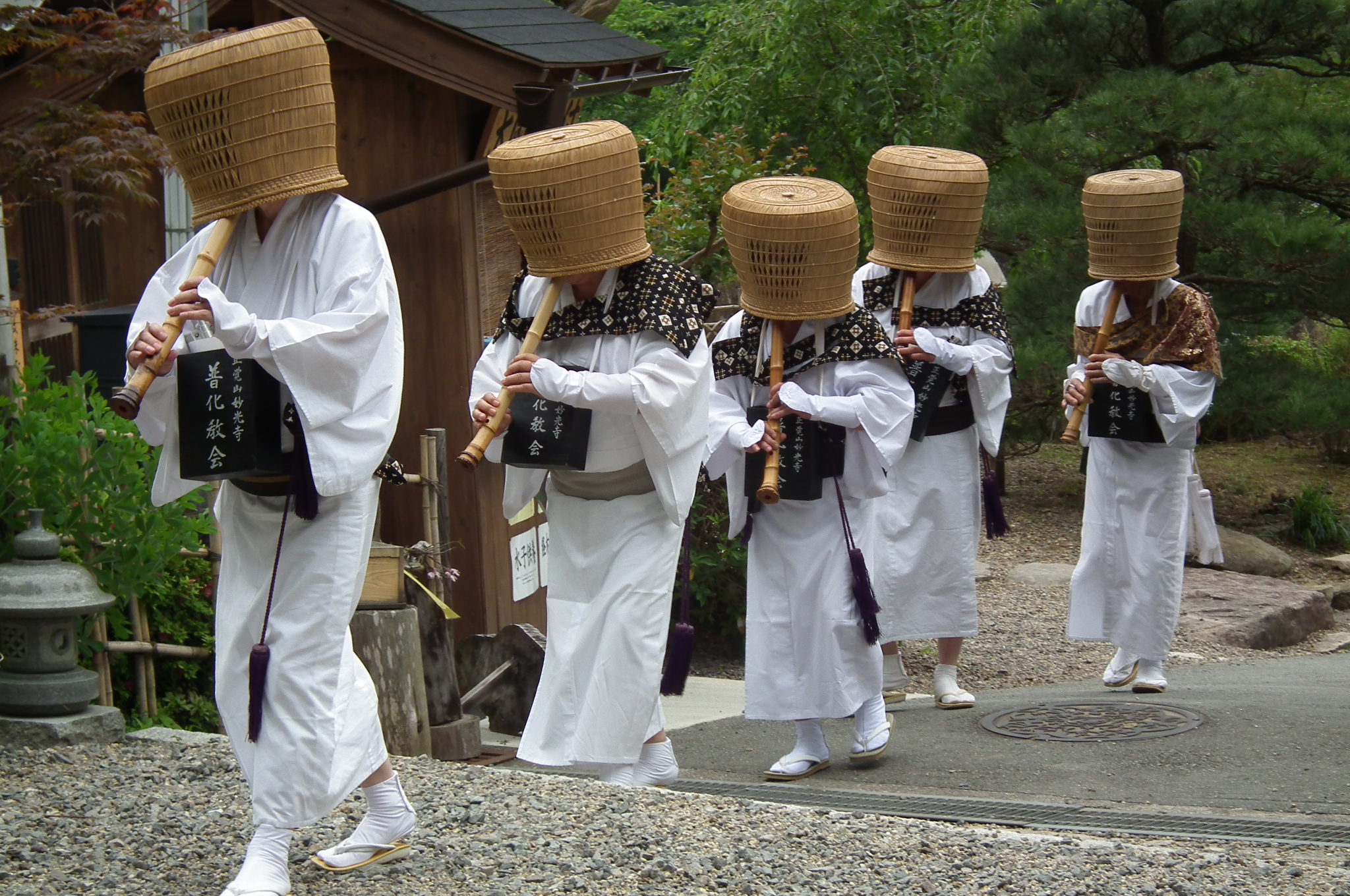
is a pentatonic, bamboo, end-blown flute with 5 holes. It is made especially famous by the Komusō; who were a group of Japanese monks of the Fuke school of Zen Buddhism.
They are known to wear a straw-woven basket on their heads (The basket is known as Tengai) with the purpose of dissolving their egos while also hiding their identities. Travel was especially strict during the Edo period. Some of the monks were warrior monks and former Samurai called Ronin. This made being incognito especially important. Originally, playing the shakuhachi was for meditative purposes and less so for entertainment.
Sketch
After the Tokugawa shogunate fell to the loyal forces of the Emperor, Komusō temples and their monks were abolished in 1871. However, playing the shakuhachi and its repertoire survived.
The Koto
is the national instrument of Japan. It is originally derived from the Chinese Guzheng or Zither, introduced in the 7th or 8th century. The first Koto was known to have 5 strings, later 7. The koto is a type of harp played on the floor, with 13 strings. (sometimes up to 25 or even 31 strings) It also has movable bridges. It is played with little picks attached to the musician's fingers.
Originally, the koto was forbidden to be played by women. When these strict rules were finally lifted, many women began to master the koto.
The Taiko
is a broad range of Japanese percussion instruments. The term Taiko refers to any kind of drum.
Kumi-daiko is referred to as a set of drums. Taiko drums have a mythological origin in Japanese folklore. Historical records indicate that the taiko were introduced by Chinese and Korean cultural influence as early as the 6th century CE. Pottery found from the Haniwa period is seen depicting taiko drums. Some taiko drums are similar to drums originating from India. Archaeological evidence shows the presence of taiko drums as far back as the 6th century; during the Kofun period. (300-538 AD) Their functions varied throughout history, such as communication, (especially for military purposes) theatrical accompaniment, religious ceremony, and concert performances leading up to today. Here are some examples.
The first video features a large Taiko drum accompanied by a shamisen.
The second video features 3 large taiko drums played by 3 drummers, The "3 tears" symbol painted on these drums is a well-known Japanese family crest. It means
"Death Before Dishonor"
The Hyōshigi
is a simple and easily recognizable Japanese traditionalinstrument consisting of two pieces of wood or bamboo often connected by a thin decorative rope. The "clappers" are played together or on the floor to create a cracking sound. Sometimes they are struck slowly at first, then faster and faster. They are primarily used in Japanese theater, especially Kabuki, to announce the beginning or end of a performance.
It took me literally an hour at least, to find the original video clip here below. Apparently, some people found it funny to add memes right at the end when he demonstrates the sound. Here is the original clip. Trying to find this original clip almost drove me insane. It's only short of a minute long.
Enjoy.
Below is another great example of various Hyōshigibeing demonstrated.
There are a handful of other traditional wind instruments I didn't mention. If you want to learn more about those, here is a great source that ties all of this together. It's kind of long, about 30 mins but I encourage you to watch it. It's very informative!
Onto modern Japanese music!
During the 19th century, Japanese music takes a different route. That is taking the influence of Western music which became very popular at the time. Japan quickly became a major consumer of Western music which evolved Japanese music forever. In 1885 Gunka, a term for Japanese military music became popular and was the most prevalent music being performed and listened to at the time. It contained local and foreign repertoire. During the early 20th century, (1930s-1940s) Japan started to diversify even more. Military music was still relevant, but in the 1930s Jazz hit the scene and was a major hit. Later, In the 1960s they inducted rock n roll music or J-rock. Other sub-genres were budded from this movement such as psychedelic and pop-rock. In the 1980s, during the height of Japan's economic boom, birthed other genres, from techno to punk, progressive rock, and even heavy metal. Immediately following the 80s, the emergence of Japanese hip-hop stemmed a growth of dance music and pop music coining the term "J-pop."
In the early 2000s, audiences, especially in Tokyo were more drawn to these genres than all five generations of music prior to this; where J-pop and hip-hop still reign supreme to this day.
However, there are groups that like to combine traditional Japanese instruments with Western rock and pop music such as "Wagakki Band". This band is a very famous music group from Japan that I accidentally stumbled upon a few years ago on youtube. In these clips, you will see an example of syncretic Japanese music. I hope, given the previous context, you can come to appreciate Wagakki band too!
To keep it short, please skip to minute 3:46 in the middle of the video to the left. You will notice the Koto right away. You'll notice a guy who appears as a monk, skillfully playing shakuhachi. Then the main vocalist begins and another girl joins in with her shamisen. Also, here's a tip; Go to the bottom of the video and click CC for the subtitles so you can understand what's being sung.
For the video to the right, skip to 3:40. You will first notice the Taiko in this one, along with the amazing shakuhachi and shamisen players.
If you took the time to read and watch the videos, thank you. I hope you learned some things and found an appreciation for traditional Japanese instruments.
For this blog, I'm interviewing my Grandmother, Sarah Elizabeth Aycoth Carter who recently turned 90 years old. I'll be asking her the interview questions we jotted down during class, in order.
Here it goes!
What is your earliest musical memory? Church choir. New Hope Methodist church. Born April 1932. I was about 10 or 11 when I first started singing in the choir. I sang in the choir till I was about 18 then went to work. I used to sing to my mother on the front porch. My Uncle Zeb said to turn that radio off.
What are the earliest artists or styles you remember listening to? I used to listen to Kate Smith. She used to sing to the soldiers during WWII. One of the songs she'd sing was America the beautiful. I used to try to sing like Kate. People said I kind of sounded like her. She sang kind of like an opera singer too.
What kinds of songs resonated with you when you were younger?. I can't remember the names of em... There used to be a lot of Christian songs on the radio I'd like. I guess didn't have a favorite particular one. I liked gospel songs. Oh yeah, Were you there? When they crucified my Lord (We then sing it a little together just then.)
Did you listen to mainstream music or something else? I don't listen to very much music now, but I like to watch songs during televised church on Sunday morning... but I haven't listened to any this Sunday morning.
Did the style of music you listened to influence other areas of your life, like how you dressed or who you hung out with? I didn't hang out with anybody because I had to stay home to take care of my mother. She wasn't able to get up or feed herself for as long as I can remember. A woman named Lily Ross helped take care of my mom too when I went to school when I turned 6 years old. I was in 11th grade when Lily left and got married and then I had to take care of my mother by myself.
How did your parents feel about the music you listened to when you were younger? Mother liked music, she used to play the organ and the piano and the guitar. She used to sing. She had a nice voice-When she was able- before she had a stroke. But I wasn't there then- it happened when I was still little. I wasn't old enough to remember this is based off what I was told. My daddy's brother Sam Aycoth played the piano for the church choir at New Hope.
How did you listen to your music? What kind of technology did you use? Back then there was no tv, so I'd hear her on the radio. I'd hear music at church if it wasn't the radio.
How has change in technology changed what you listen to? TV came out in 1952 - but we didn't have a tv until I got married and my husband and I got a TV. Muntz TV was the name of it. Tutti Fruity came out later on and I liked that (She demonstrates by singing and I do a google search and found the song she remembers- Instantly she gets up and starts dancing)
Where did you listen to your music? Usually church or at home on the radio
What kind of concerts did you go to in high school or later? What were they like? No I didn't get to go to any concerts. I was too busy
Did you ever learn an instrument? I tried to play the piano but I never had lessons. I could play a little tune by ear though but not much.
Why did you choose that instrument? I always wanted to take piano lessons but never could go anywhere to get lessons.
Did you like it? I loved piano I always wished I could play piano.
Or did you sing in a school choir? What was that like? Or church choir? What kind of music did you have at church? Organ, piano, guitar. (refer to question 1)
Did your musical education affect what you listened to? No, I never had any music lessons I just listened to what music was around me at the time.
What kind of music do you listen to today? Has it changed over the course of your life? I don't really know the name of the songs but I usually listen to the radio- whatever the music they have on - hillbilly music. I liked bluegrass music. I like most any kind of music, I like Christian music, Country music, Gospel, stuff like that.
What is your favorite album? I have some albums... They might be in the closet in here. I can't remember where I put em. I can't remember the names of em' right now.
What is your favorite music from a movie? I used to listen to movies on the radio... They'd play music from movies on the radio back then.
Is there a special song that helped you get through a rough time? Not especially, I've heard lots of music growin' up.
Is there a song that brings back a specific memory? No. I can't remember
Is there a song that you find yourself humming or singing in the shower or something like that? I don't sing in the shower. I hum in the kitchen or when I'm in the garden. Usually, gospel songs.
Do you and your spouse have a special song? No. He used to make fun of me singing. William did. Make fun of me. I used to sing songs - a lot of songs at home... All of those old songs I forgot.
What do you think about the music kids listen to today? Well, I think it's too much vulgar language in it. Some of it can be OK, I guess it depends on what it is.
What do you think of my music? I think it's good to hear you singing the Christian and Gospel songs you sing.
What music do you suggest I listen to? There's so much I can't remember...Gospel and Christian music, some Country music, hillbilly music, we mentioned bluegrass too. That's all good stuff to listen to.
If you could make the world listen to one song, what would it be? Well, there's too many good songs. Oh...How great thou art! (She starts singing)
"Oh Lord my God
When I in awesome wonder
Consider all the worlds
Thy hands have made
I see the stars
I hear the rolling thunder
Thy power throughout
The universe displayed
Then sings my soul
My Savior, God, to Thee
How great thou art, How great thou art
Then sings my soul
My Savior, God, to Thee
How great Thou art, How great Thou art"
That's a pretty song. Billy Graham used to have a lot of that music on his program. I like Billy Graham.
Thanks for giving me your time, Grandma. "Oh I got plenty of time, that's all I got right now"
I’ve never taken a liking to modern or contemporary country music. It has this twangy and sad sound and lyric content that combines contemporary instrumental sounds with singers of an accent that instantly reminds me of my family on my mom’s side. I assumed Country... was Country and it all sounds pretty much the same; not realizing there are different forms and styles of country music. When I was watching an episode of “King of the Hill”; Hank Hill, the main character, is playing his guitar in the alley to a tune so sweet and warm. I was amazed and so drawn to the sound.
Connie, the daughter of Hank’s Laotian neighbor, Khan, overhears it from her window and is also captivated by what she hears. Connie is always under a lot of pressure from her dad to enter an Ivy League school and become a classical violinist. When Connie hears this gorgeous tune played by Hank, she is compelled to meet him in the alley and asks him to play it again. She then harmonizes using her violin. When done, Hank corrects her terminology by saying, “When you’re playing bluegrass music, it’s called a fiddle” The combined harmonies of Hank’s guitar and Connie’s fiddle blew me away. Instantly, my interest in bluegrass music had sparked; solely through this one episode of the popular cartoon created by Mike Judge.
Here is a clip of this moment.
Bluegrass was developed in the Appalachian region of the United States. The music drew its character from old-time and traditional European folk music. The settlers of the Appalachian region were mainly English and Scottish who had brought their musical traditions and instruments here from their homelands. This is why Jigs and Reels, especially when using the fiddle were crucial for the new but ever-growing style. Interestingly, enslaved West African musicians are credited with being the first people to introduce the banjo to the United States, which became a primary instrument used in the development of bluegrass. Early stages of bluegrass were often inspired by or based off of so-called "Child Ballads" that are derived from England, Ireland, and Scotland. Most of these ballads told a story or narrative that was relative to the listener; paired with a dance and a fiddle. Sometimes other string instruments were used but the fiddle was more prominent.
For example, "Pretty Saro" is a ballad from England.
The song "Cuckoo Bird" also originated in England.
The songs "Leather Britches" and "Soldier's joy" are examples of ballads that originate from Scotland.
Listen here below
The fiddle and guitar are believed to have been traced to the earliest days of bluegrass. It's commonly known that the first European settlers are responsible for bringing fiddles and guitars to the Appalachian region. The fiddle was seen as particularly important since most of the ballads used fiddles. Guitars were often used just as much, but historians mostly agree the fiddle was seen as more important than the guitar. The role of these instruments has evolved over time along with different instruments added in, taking on a wide variety of importance and use throughout the development of bluegrass. In modern bluegrass ensembles, the Bass is considered an integral and important instrument for bluegrass ensembles.
Originally, evidence has shown that the cello was used more during the inception of bluegrass, instead of the bass. Eventually, the cello was deemed more of a classical instrument and was dropped from bluegrass altogether. The double bass, or, simply known as the Bass, is a common instrument during the 20th century. It was essential to the early formation of the bluegrass genre. The cello, however, was not re-introduced to bluegrass until the 1990s.
The Banjo is probably the first instrument you'd think of when you hear the term "bluegrass".
Banjos carry an interesting and deep history that you wouldn't have thought to be the case; due to their current use and association with American Roots music played mainly by white musicians. It is widely accepted by scholars that the banjo was first brought to America by African slaves. In 1781 Thomas Jefferson, stated in his writings (about the slaves on his own plantation) "The instrument proper to them is the Banjar; which they have brought hither from Africa". Most of these early "Banjars" were made from gourds and played with a fretless neck. There are no recordings of these indigenous, hand-made banjars but from surviving illustrations, scholars concurred that they used heavy strings and likely had a deep and or mellow sound to them.
Although done many years prior, the earliest eyewitness account of the banjo and fiddle being played together in the South was in the year 1847.
This was the moment, considered to be the true origin of modern bluegrass.
Eventually, the original hand-made banjars were dropped and replaced by the modern 5-string banjo. According to music historians, Earl Scruggs made the 5-string banjo especially revered in the bluegrass genre using his three-finger playing style.
The Mandolin is another one of the most common instruments used in modern bluegrass. There are little to no traces of the mandolin being used in the beginning stages of bluegrass. It would have to wait until the 20th century to gain popularity through the business efforts of the Gibson Guitar Co., which produced and sold a flat-back type of mandolin mainly used in mandolin orchestras. These later lost popularity in the 1920s; however, at the same time, they began to be used in a variety of traditional Appalachian mountain folk music. By the 1930s, Bill Monroe, a Kentucky-born fiddler, mandolinist, singer, and songwriter, is credited with being the creator of the bluegrass genre via him and his band "Bill Monroe and the Bluegrass Boys". Bluegrass is literally a strain of grass native to Kentucky.
The collaboration of Irish and Scottish fiddle tunes with the American Banjo had already been done, but Bill Monroe was the first musician to famously, combine all of these musical aspects together while also integrating the Mandolin at the same time. Since then, he is considered "The Father of Bluegrass". The Bluegrass genre had not officially been named until Ralph Stanley credited Bill Monroe with the term "Bluegrass".
Quote: "Oh, (Monroe) was the first, but it wasn't called bluegrass back then. It was just called old-time mountain hillbilly music. When they started doing bluegrass festivals in 1965, everybody got together and wanted to know what to call the show, y'know? It was decided that since Bill was the oldest man and was from the bluegrass state of Kentucky, and he had "The Bluegrass Boys", it would be called "Bluegrass".
- Ralph Stanley
The Resonator Guitar or Dobro is another instrument that became common in contemporary bluegrass. It was first introduced by Josh Graves who played with (Lester) Flatt and (Earl) Scruggs in the mid-1950s. The instrument wasn't widespread until Gerry Douglas and Mike Aldridge began to popularize it later through their music.
There are currently 4 generations of bluegrass, the fourth being the current generation. The following generations after the first incorporate traditional styles but with a modern approach with the evolution of each generation. However, the first generation acknowledging the original, great bluegrass musicians such as Bill Monroe and Earl Scruggs is considered to be the golden age of bluegrass.
Blue Moon of Kentucky (1946) is my favorite song by Bill Monroe, which was covered by Elvis Presley, making the song skyrocket in popularity. It's been covered by many other famous musicians over the years such as Patsy Cline, Ricky Skaggs, and even Paul McCartney.
I must add another nod to King of the Hill for paying homage to this great song, including an illustrated cameo of Charlie Daniels. Awesome!
One more bluegrass song. Another favorite of mine, I tell you what.
If you got to the end of this, thank you. I hope you enjoyed it.
You may remember if you read my first blog, that I've taken an interest in Kabuki Theater. I've recently discovered there is an even older form of Japanese theatre that predates Kabuki by 200 years called "Noh" Theater. Here I'll explain both forms of Japanese theatre, Noh and Kabuki, and how the importance of strictly regulated gender roles was established. Noh and Kabuki, although similar in origin are very different stage arts. Let's start from the beginning. The origins of Noh trace back to a thousand years ago. Noh is actually a combination of two different forms of performing art. One form called "Sarugaku" involved a variety of dance, magic, singing, and comedy. The other, being a ritual ceremony, is a kind of prayer for a good harvest before planting rice called "Dengaku." These two performing arts were combined in the 13th century into one stage art that began to be performed at Shinto rituals that took place in shrines. Here is a photo of a Shinto shrine to get an idea.
Noh, was loved by the Samurai. We'll get to the samurai aspect soon but I want to add more context. Noh was completed by two people; a father named Kanami and his son, Zeami. They are the ones who completed Noh; remaining the same as it is performed today. The father changed the monotonous singing into a more rhythmic kind of music. The son added charm and delicacy to the comical stories, focusing on the acts of singing and dancing. Their form of Noh was well received by the Shogun during the Muromachi era. (1336-1573) Originally, Noh was enjoyed by local people in public shrines, however, the Shogunate saw it as a noble performing culture and made these performances accessible only to people in power, such as samurai. Later, during the civil war era (1467-1615) Three of the most important warriors in the history of Japan, also fell in love with the Noh performing art. Their names were Oda Nobunaga, Toyotomi Hideyoshi, and Tokugawa Iyeyasu. During the Edo period, started by Tokugawa Iyeyasu, Noh became a kind of general education for Samurai.
Noh was almost completely lost by westernization and World War II but managed to survive through the dedication of the Noh actors. In 2001 UNESCO (The United Nations Educational, Scientific and Cultural Organization) declared Noh "A masterpiece of human oral tradition and intangible heritage". Regaining its popularity in and outside of Japan. Originally, only men were allowed to act in Noh, but after WW2 women were finally allowed to have roles in Noh theatre. Today, anyone can learn the song and dance of Noh theater, and participate as if it were a sport or musical instrument. Now let's look at Kabuki theatre. I'll give a brief historical context and then we'll compare the two. The origins of Kabuki can be traced to about 400 years ago. Shortly after the 150 year long civil war era had finally come to an end, the beginning of this peaceful era gave way to a variety of new performing arts. The "Kabuki dance" was first performed by a woman named Okuni. It was one of the most popular performing arts at the time. Kabuki comes from a verb called "Kabuku" which translates to "Doing strange things in wacky clothes" The elaborate and flamboyant Kabuki dance was very amusing to the common people. However, the dancing women were starting to "Disturb the morals" due to some of the actors also working as courtesans. So the shogunate (Samurai government) regulated women from dancing on stage and only men were allowed to perform. This only created more problems. Young boys began to act and dance in Kabuki instead. Soon, this also was disturbing the moral code of society as well. Finally, both women and young boys were forbidden to be on the Kabuki stage. To this day, women are not allowed to perform in Kabuki, and female roles are played exclusively by men. Kabuki also went through a survival crisis due to westernization during WW2. The quirky and eccentric style of Kabuki was thought of as an "uncivilized" form of art in Westernized Japan. Many Kabuki theatres were burnt down during the War. Luckily, in 1951, new theatres were built and Kabuki regained its popularity.
In 2005 UNECSO declared Kabuki as "A masterpiece of human oral tradition and intangible heritage". As it was done with Noh 4 years prior.
Key differences between Noh and Kabuki. The stories of Noh were more related to religion and the dancing mimicked the movements of martial arts used by samurai. Noh would use minimal stage props. The main stage tool was the "Noh mask". A mask that would attempt to portray Japanese deities or spirits, featuring multiple emotions in one face. Today, any gender can perform in Noh theater. The stories of Kabuki are more straightforward and focus on the emotions of the characters. Kabuki uses many stage props and the stage sets are elaborate and flashy. Instead of masks, Kabuki features a unique form of make-up instead. Only men are allowed to perform in Kabuki to this day. The female roles in Kabuki are strictly performed by men only. When women were regulated from acting in Kabuki in the past, there was a group of people who secretly protected the dance culture. This became known as "Nihon-Buyo". The Japanese traditional dance we know of today. Instead of acting in Kabuki, women are allowed to participate in this form of dance instead.
Here is a brief video about Kabuki.
I hope you found some of this interesting. Kabuki is so captivating and filled with a rich and layered history.
Here is another video that is relative to the information provided earlier. I hope you can enjoy it.
I absolutely cannot start my morning after I wake up without some chill music throughout my morning until I have to leave to go wherever that may be. The very first thing I do when I wake up is put on some kind of lo-fi or relaxing guitar music to help me stay focused and have a mindset for a positive and productive day. It really makes my morning routine go a lot smoother and it becomes more enjoyable; when normally, it would be tedious and frustrating. The same goes for when I get in the car. The first thing I do before buckling, adjusting mirrors, etc... is to find some music I like. I normally listen to the classical radio station because it's relaxing and puts me in a good mood for the drive. Also; a shower with music is a lot better too. (No million-dollar ideas happening anyway) Music enhances pretty much everything in life; Why not have music playing before everything you do?
Another example of a ritual involving music; although cliché sounding for this blog, is the happy birthday song but in Italian. I used to work for Carrabba's Italian Grill and every time someone's table had a birthday, I was asked to sing Italian Happy birthday. It was fun for a while at first but sometimes there would be so many birthday tables...about 8 or 10 sometimes all in one evening. It would be pretty much awkward and annoying by the third or fourth time being sung in a row. Most of the time I wasn't even tipped. Although, now when it's someone's birthday, I have this urge to sing happy birthday in Italian to them. I know it did mean a lot to some of the patrons at the restaurant, though. I've been told a lot of the regulars miss having "the opera singer" at that Carrabba's location.
Another music ritual that comes to mind is; before any baseball game, you can guarantee that the national anthem will be sung. Usually with some unnecessary, virtuosic vocal ornamentation. Maybe with a pop or r&b stylistic twist but nonetheless, it will happen. I grew up playing and watching baseball. It's just something that happens before any baseball game. Being an American Past-time, it's only natural to stand, hand over heart, with respect and pride as you listen with everyone else in honor of this country. It's only appropriate to do before a purely American game with so much history behind it. I trust that everyone knows all the lyrics to this tune. "Take me out to the ballgame"
Music has a ritualistic aspect in everyone's lives for a lot of different reasons. It's interesting. I wouldn't assume people really think too much about it, especially referring to it as a "ritual". Although it's happening so much every day, whether it's big events like weddings, funerals, birthdays or sporting events; to just a simple morning routine.
I'm really enjoying the beginning of this class because believe it or not, my "go-to" music is traditional native American music on youtube. Whenever I'm having invasive thoughts cycling through my head, or need to find peace in a situation, I can rely on this recording to reset myself. The chanting I find powerfully moving and strangely relaxing. It brings a sort of emotion that I've only been able to experience through Native American Music.
Whenever I'm in a good mood and just chilling, I like to listen to jazz or a mix of genres. I took a jazz ensemble and history class in community college and from that, a love of jazz was born.
My Jazz professor hated the word "Jazzy" but I think it's appropriate. His reason was that he thought "jazzy" was disrespectful to the world of jazz and its creators. I disagree. I think the term can apply to a lot of music. I think he just takes things too seriously. The man is a brilliant trumpet player and pianist though. Despite any disagreements with his philosophy, or how the class was run; I highly respected him for not only his musical abilities but for opening my mind and soul to the world of jazz.
Also, Disney's movie Soul is incredible and if you have any understanding of jazz then you can enjoy the movie even more.
When I was in my mid-teens I'd taken a personal interest in opera, before ever trying to sing or be in one. I convinced my mother to take us to a local movie theater where they were playing Madame Butterfly, an opera by composer Giacomo Puccini. This was my first time seeing an opera. I was affected deeply by it.
Soon after, I'd audition for Phantom of the Opera and take the lead role of Phantom. The following year I took a position to sing with the Charlotte opera company for years to come. Below is a clip of the finale from the same Met Opera production I'd seen all those years ago.
Music that I don't really identify with would be modern-day rap/hip-hop.
I like 80's artists such as Tupac, Biggie, and even Snoop Dogg. They're fun and easy listening and sometimes contain inspiring messages that still have relevance to today's issues.
However, today's artists, specifically Cardi B, for example; is beyond explicit for no good reason other than for shock value. I can understand why people may ignore the lyrics because they claim to "just listen to the beat" but I don't think that sole reason is justifiable. She definitely isn't someone to be looked up to. I would keep her music and music similar to it far away from children's ears as possible, which is a whole other topic issue.
I don't even feel comfortable sharing an example, but here.
I've practiced Japanese Martial Arts for a lot of my life but only recently delved into the world of Japanese Kabuki theater. The music, elaborate costumes, and stories attempted to bring to life an art form, consisting of prints on woodblocks called Ukiyo-e. This woodblock print art form was popular in the Edo period when Samurai Warriors were still an active part of society.
Traditional Japanese instruments have a hauntingly unique sound to each of them.
The Shamisen is a guitar-like traditional string instrument.
The Shakuhachi is a specific type of flute traditionally made in Japan.
The Taiko is the name of any type of drum or percussion instrument used.
The Hyōshigiis a simple Japanese traditionalinstrument consisting of two pieces of wood or bamboo often connected by a thin decorative rope. The "clappers" are played together or on the floor to create a cracking sound. Sometimes they are struck slowly at first, then faster and faster.